Why do snowflakes have six sides?
Because of how water molecules link up when they freeze. Ice grows in a six-fold, hexagonal pattern, and the temperature and humidity a flake passes through on the way down decide the rest of its shape.
Quick Answer
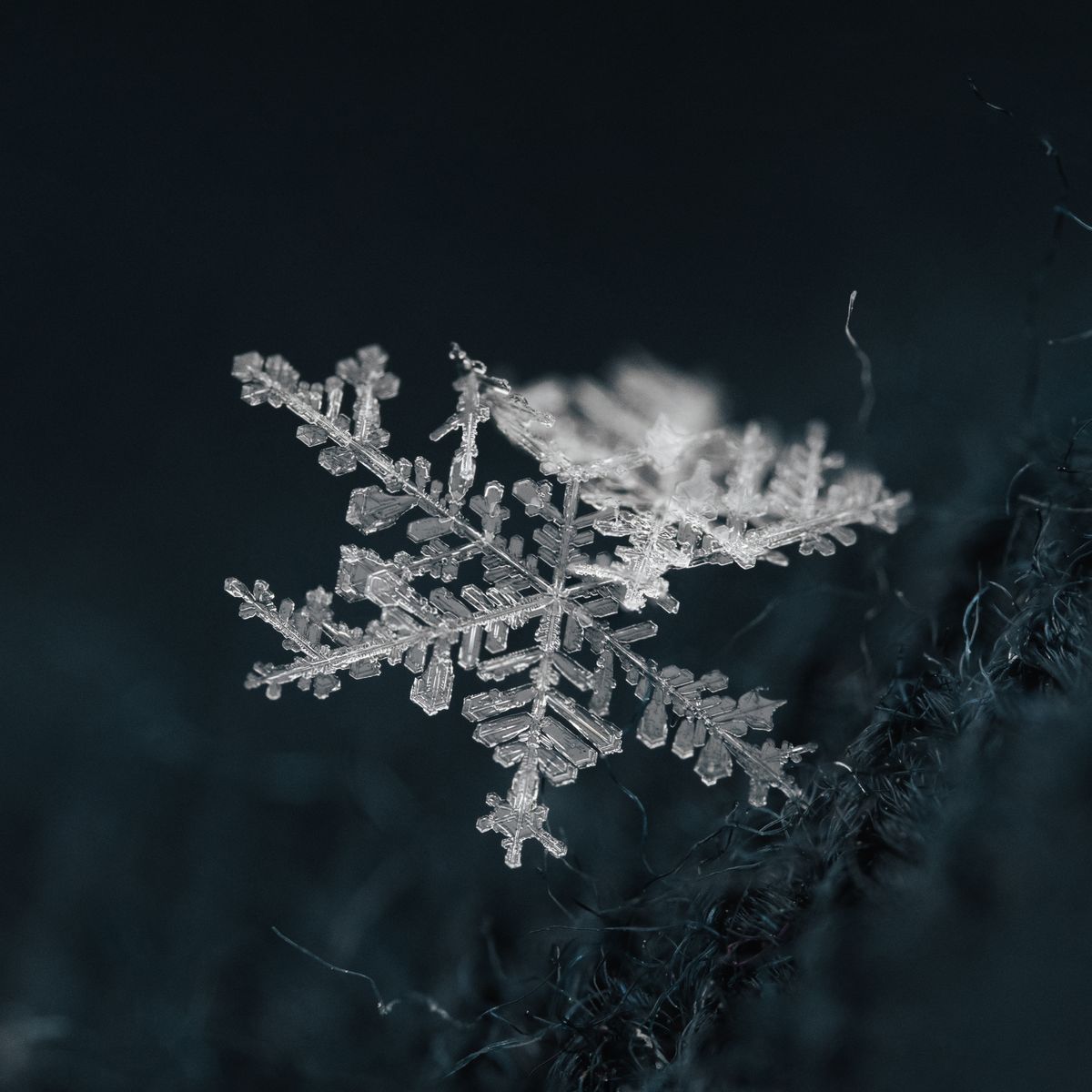
Snowflakes have six sides because of the structure of ice. When water freezes, its molecules link up through hydrogen bonds into a lattice of hexagonal rings, and a growing crystal keeps that six-fold symmetry. That’s why classic snowflakes have six arms or six corners. The detailed shape comes from the weather: as a crystal falls through clouds, temperature and humidity change, and they affect how fast different parts grow. Because all six arms of one flake pass through the same conditions at the same time, they tend to look alike, while no two flakes follow exactly the same path. Wilson Bentley, a Vermont farmer, took the first photograph of a single snow crystal in 1885 and went on to photograph more than 5,000 over 46 years. Centuries earlier, in 1611, the astronomer Johannes Kepler had written a short essay wondering why snowflakes have six corners.
By the Numbers
Key Facts
- The reason
- Water molecules form a hexagonal lattice when they freeze
- The shape
- Set by the temperature and humidity a flake passes through
- Two alike?
- Nearly identical flakes are possible, but not identical down to the molecule
- First photo
- Wilson Bentley, 1885
How a snowflake grows
- Water vapor freezes
Vapor in a cold cloud freezes onto a tiny particle.
- The lattice sets the symmetry
Water molecules lock into hexagonal rings, giving the crystal six-fold symmetry.
- Arms sprout and branch
As temperature and humidity change, the arms grow in different ways.
- The flake falls
Each flake’s path through the cloud leaves its own pattern.
Why six
Each water molecule is one oxygen atom with two hydrogen atoms. When water freezes, the molecules link up through hydrogen bonds, and their lowest-energy arrangement is a lattice of hexagonal rings. Building outward from that lattice, a crystal naturally grows with six-fold symmetry, which is why snowflakes so often have six arms.
Why each one looks different
The shape of a snow crystal depends on the temperature and humidity it meets as it falls, and those conditions change as it moves through a cloud. The six arms of one flake grow in the same conditions at the same time, so they tend to match each other. A different flake that took a different path ends up with a different pattern.
Are two ever alike?
Bentley, the first person to photograph a snow crystal, was also the first to claim that no two are alike. In 1988, Nancy Knight of the National Center for Atmospheric Research found two that looked identical under a microscope. Caltech physicist Kenneth Libbrecht says that at the atomic level, even seemingly identical flakes have different numbers and arrangements of water molecules.
Myth vs. Fact
MythNo two snowflakes are alike.
FactIt’s nearly true. Bentley found thousands that differed, but in 1988 Nancy Knight found two that looked identical under a microscope. On the atomic level, no two are the same.
MythEvery snowflake has six points.
FactMany do, but snow crystals also grow as plates, columns and needles, depending on the temperature and humidity.
The Bottom Line
Snowflakes have six sides because water molecules lock into a hexagonal pattern when they freeze, and the weather each flake passes through decides the rest of its shape.
Sources & Further Reading
- University at Buffalo — The chemistry of snowflakes, explained
- Smithsonian Magazine — The Art and Science of Growing Snowflakes in a Lab
- Smithsonian Magazine — These 15 Stunning Microscopic Snowflake Images Helped Change the Way We See the World
- Guinness World Records — First identical snow crystals
- Kenneth G. Libbrecht — Snow Crystals (arXiv)