Why does the Moon look bigger near the horizon?
It’s an illusion. The Moon always covers about half a degree of sky, and cameras show it the same size. Your brain enlarges it near the horizon, and scientists still debate exactly why.
Quick Answer
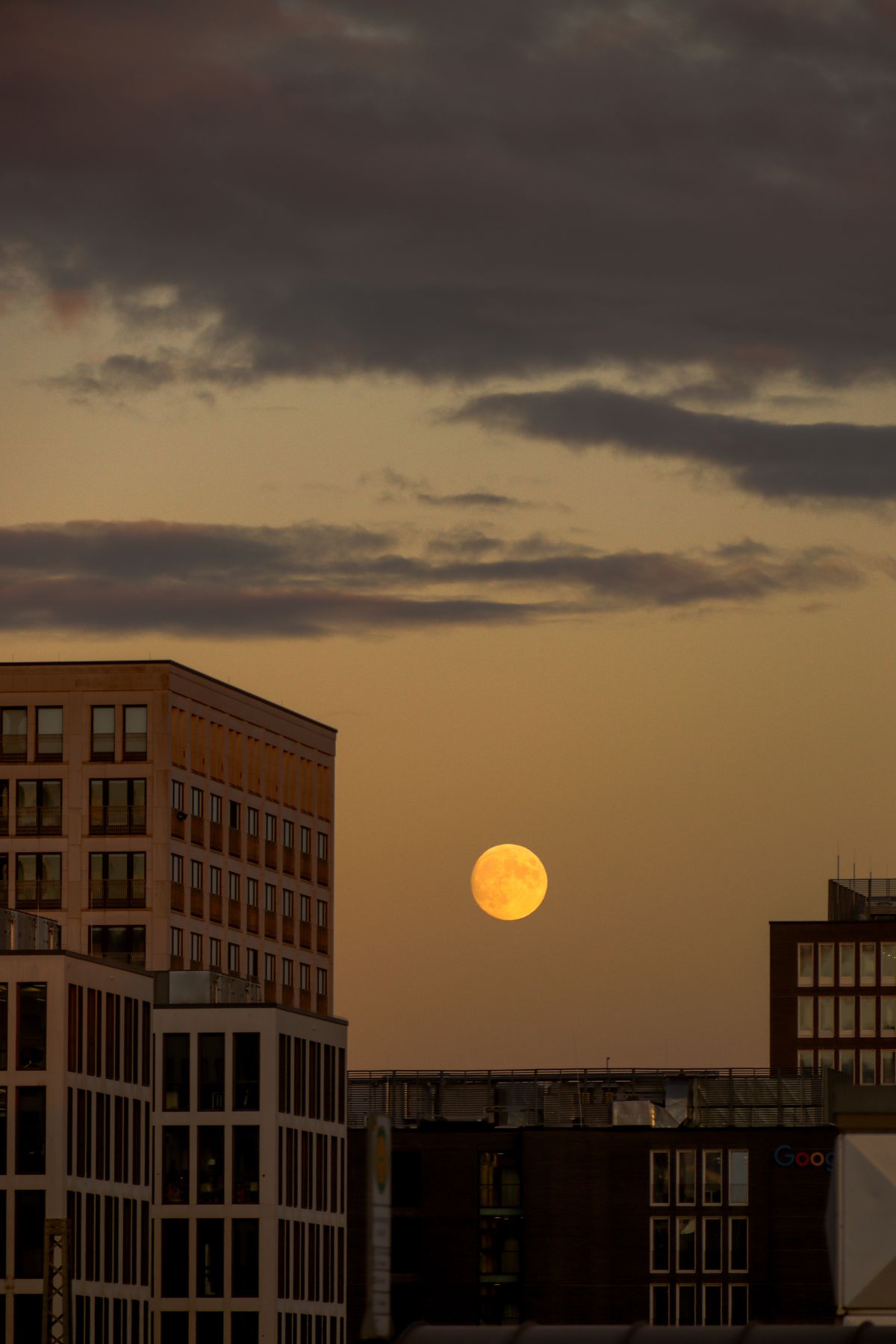
The Moon doesn’t really grow when it rises. It always spans about half a degree of sky, roughly the width of a pencil eraser held at arm’s length, and photos taken low on the horizon and high overhead show the same size. If anything, the rising Moon is slightly farther away, by up to about one Earth radius. The enlargement happens in your brain, and even though people have noticed it for thousands of years, NASA says there’s still no rock-solid explanation. A leading idea is that the brain judges the horizon Moon to be farther away, because it’s seen beyond buildings, trees and landscape, and so perceives it as bigger. One size change is real, though: a full Moon at the closest point in its orbit, a supermoon, can look up to 14% wider than one at its farthest.
By the Numbers
Key Facts
- Short answer
- It’s an illusion created by your brain
- Real size in the sky
- Always about half a degree across
- Leading idea
- The brain judges the horizon Moon as farther away, so it seems larger
- A real size change
- A supermoon can look up to 14% wider than the smallest full Moon
Test it yourself
- Wait for moonrise
Find the Moon when it’s low and looks huge.
- Measure it
Hold a pencil eraser at arm’s length and note how much of the Moon it covers.
- Measure again later
Repeat when the Moon is high in the sky. It covers the same amount.
- Or take two photos
With the same zoom, a camera shows the Moon the same size at both heights.
A trick of the brain
Your eyes see the same half-degree disk all night. The difference is in how your brain interprets it: near the horizon, with trees and buildings for comparison, the Moon looks enormous; high in an empty sky, it looks small.
The leading explanations
Most explanations involve how the brain judges distance and size. Objects near the horizon seem farther away, and the brain may compensate by making the Moon look bigger. Comparison with nearby objects may add to the effect. None has settled the debate.
Supermoons are different
The Moon’s orbit isn’t a perfect circle. When a full Moon happens near its closest approach, it really does look slightly bigger and brighter: up to 14% wider than a full Moon at its farthest point. That has nothing to do with the horizon illusion.
Myth vs. Fact
MythThe Moon is closer when it rises.
FactIt’s actually slightly farther away than when it’s overhead.
MythThe atmosphere magnifies the rising Moon.
FactIt doesn’t. Photos show the same size; the air can redden the Moon and slightly flatten it, but not enlarge it.
The Bottom Line
The Moon only looks bigger near the horizon: it’s the same half-degree disk all night. Your brain does the enlarging, and scientists are still debating exactly how.