Why do geese fly in a V?
To save energy. Each bird rides a pocket of rising air coming off the wingtip of the bird ahead, and the birds take turns in the tiring lead. Studies of pelicans and ibises found savings of about 11 to 14%.
Quick Answer
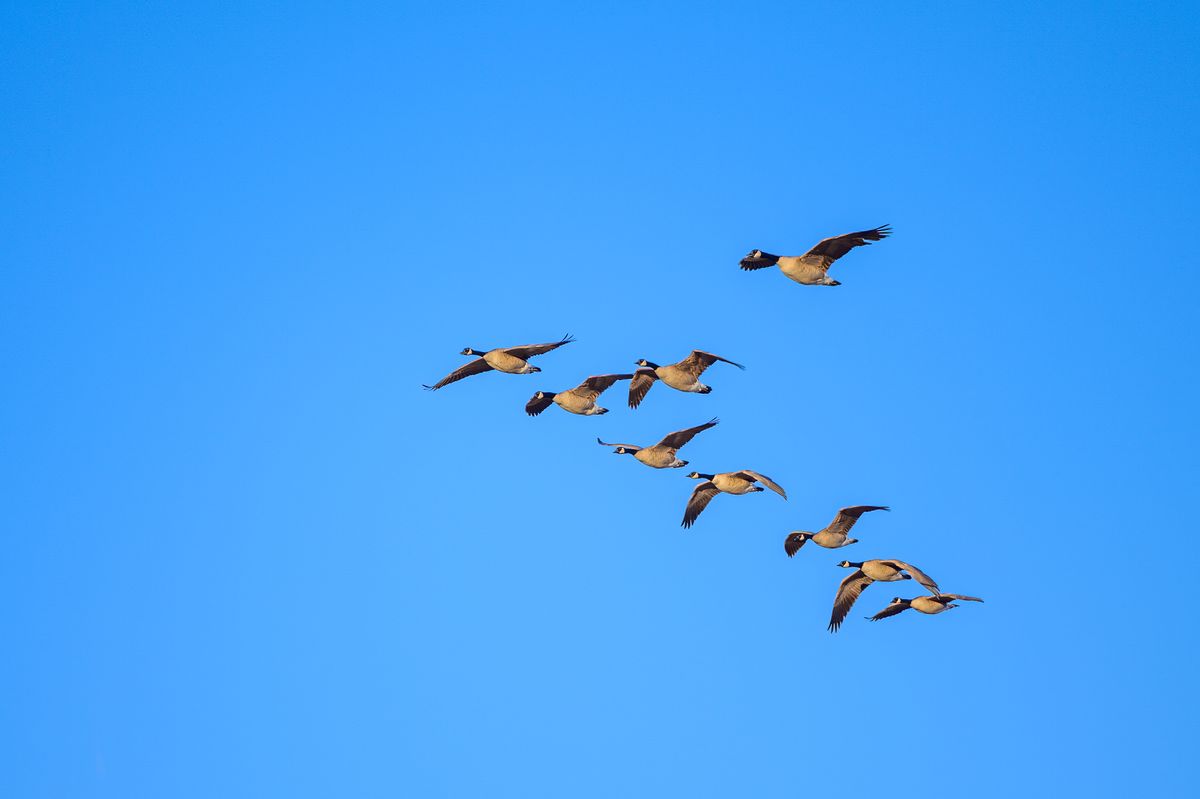
Big migrating birds such as geese fly in a V because it saves energy. As a bird flaps, air swirls off each wingtip, and just behind and to the side of the wing that air rises. A bird flying in that spot, called the upwash, gets a little free lift. The lead bird doesn’t get that help, so the flock takes turns up front. The first hard evidence came in 2001, when scientists fitted great white pelicans with heart-rate monitors: birds flying in formation had lower heart rates, flapped less often and glided more, saving roughly 11 to 14% of their energy. In 2014, a study of northern bald ibises with GPS loggers showed each bird positioned itself in the best spot and even timed its wingbeats to ride the upwash. In 2015, a follow-up found ibises closely matched the time they spent leading and following. A 2026 model estimated about 11% less power in the V. The shape may also help birds keep each other in view.
By the Numbers
Key Facts
- Main reason
- Saving energy on long flights
- How it works
- Each bird rides rising air (upwash) off the wingtip of the bird ahead
- Energy saved
- About 11–14% in studies of pelicans and ibises
- Teamwork
- Birds take turns in the lead, which gets no free lift
How the V saves energy
- Air swirls off the wingtips
Each flap leaves a spinning vortex of air behind each wingtip.
- The air rises just outside it
Behind and to the side of the wing, that air moves upward: the upwash.
- The next bird rides it
A bird flying in that spot gets extra lift and can flap less.
- The leader rotates
The front bird gets no upwash, so birds take turns leading.
Proof from pelicans
In 2001, researchers fitted great white pelicans with heart-rate recorders. Birds flying in formation had lower heart rates and flapped less often than birds flying alone, and they glided more, saving roughly 11 to 14% of their energy.
Precision flying
In 2014, scientists fitted a flock of northern bald ibises with GPS loggers. The birds flew in the spots where theory says the upwash is best, and they flapped in step with the bird ahead so their wings followed the same path through the rising air.
Taking turns
A 2015 study of ibises found that birds closely matched the time they spent leading with the time they spent following, a kind of fair trade. A 2026 aerodynamic model from Brown University added that following birds save energy mainly by making shallower flaps.
Myth vs. Fact
MythThe leader is the boss of the flock.
FactThe lead bird works hardest, and birds take turns in front.
MythBirds fly in a V just to follow the leader.
FactThe main benefit is aerodynamic: each bird rides lift from the wing ahead.
The Bottom Line
Geese fly in a V to save energy: each bird rides rising air off the wing ahead, and the flock shares the hard work of leading.
Sources & Further Reading
- Nature — Weimerskirch et al., Energy saving in flight formation (2001)
- Nature — Portugal et al., Upwash exploitation and downwash avoidance by flap phasing in ibis formation flight (2014)
- PNAS — Voelkl et al., Matching times of leading and following suggest cooperation through direct reciprocity during V-formation flight in ibis (2015)
- Brown University — Birds’ flying ‘V’ formation saves energy with flatter flaps (2026)
- PBS NOVA — Why Do Birds Fly in Vs? Endangered Bird Solves the Mystery