Why don’t woodpeckers get concussions every time they peck?
Their anatomy and pecking mechanics distribute impact very differently from a human head impact. Scientists still debate exactly which features matter most.
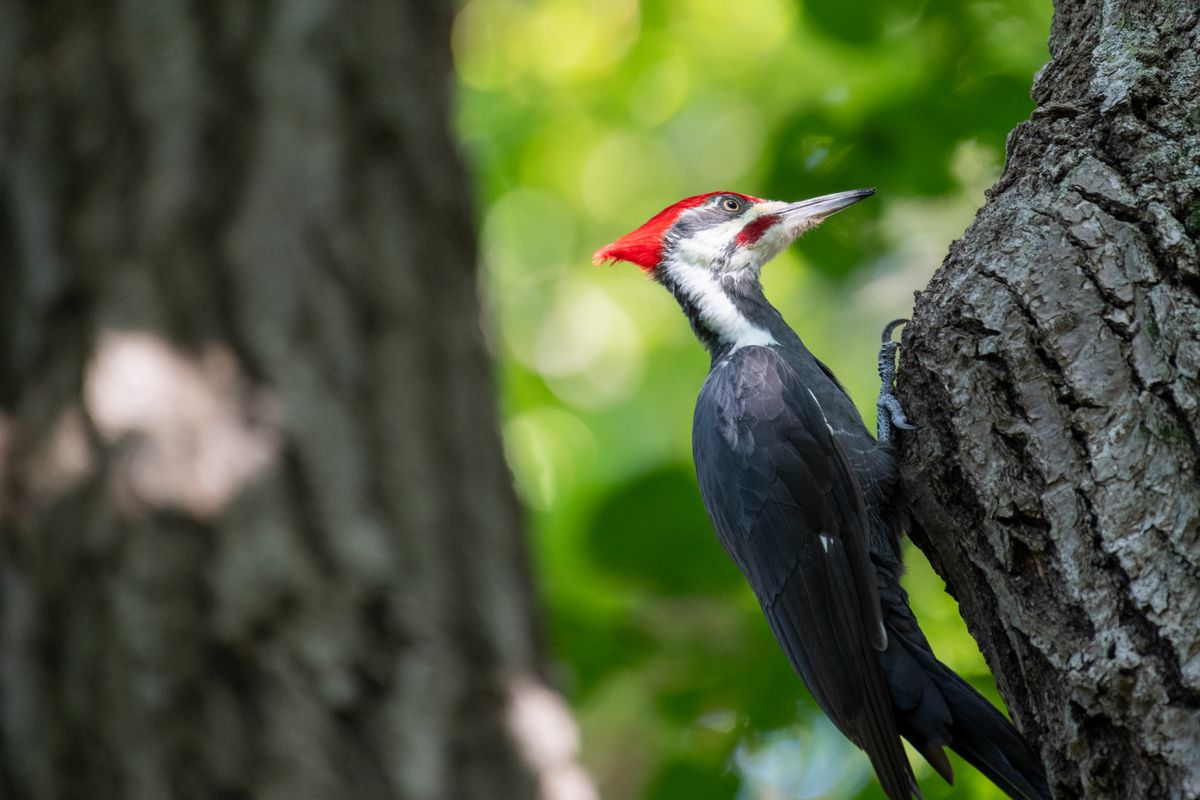
Quick Answer
Woodpeckers can strike wood at remarkable speed without the kind of obvious brain injury a similar impact could cause in humans. Research points to a combination of factors: small brain size, skull and beak structure, tight brain fit, impact direction and the mechanics of the strike. Earlier studies emphasized “shock-absorbing” anatomy, while newer work argues that the head may behave more like a stiff hammer, with the small brain and very short impact duration helping keep tissue strain within tolerable limits. The honest answer is not one magical sponge-like structure. It is a package of anatomy, scale and mechanics.
By the Numbers
Key Facts
- Not one trick
- Protection appears to come from multiple anatomical and mechanical factors
- Scale matters
- A small brain and brief, directed impacts behave differently from human head trauma
- Research evolves
- Scientists continue debating how much “shock absorption” versus stiffness matters
What happens in a single peck
- The beak strikes
The beak hits the tree at 6–7 meters per second and stops almost instantly.
- The head stays stiff
High-speed video in a 2022 study showed the skull decelerating just like the beak, with no measurable cushioning in between.
- The force runs straight
Pecks are driven along the long axis of the head, avoiding the twisting motion that is especially damaging in human brain injuries.
- A small brain takes the hit
A tiny brain experiences far less pressure from the same deceleration than a large one, keeping each peck below estimated concussion levels.
An engineering problem solved by evolution
High-speed studies have measured pecking kinematics and modeled forces through the beak, skull and brain. The geometry directs much of the force along the long axis of the head rather than producing the twisting motion that is especially damaging in human brain injury.
The hyoid is interesting, but not a helmet
Woodpeckers have an unusual hyoid apparatus that wraps around the skull and supports the tongue. It has often been described as a shock absorber, but current biomechanics cautions against turning any single structure into the whole explanation.
Why this does not make football helmets simple
A woodpecker’s tiny brain, head geometry, strike direction and milliseconds-long behavior are very different from a human athlete experiencing unpredictable translational and rotational impacts. Copying one woodpecker feature does not automatically solve human concussion risk.
Myth vs. Fact
MythWoodpecker skulls work like built-in shock absorbers.
FactA 2022 study filming three species found no measurable shock absorption. The head acts like a stiff hammer; cushioning would actually weaken each peck.
MythThe hyoid bone is a seat belt for the brain.
FactThe tongue-supporting hyoid that wraps around the skull may help stiffen the head, but researchers caution that no single structure explains the protection.
The Bottom Line
Woodpeckers don’t cushion the blow. Their heads work like stiff hammers, and their tiny brains feel far less pressure from each strike than ours would.